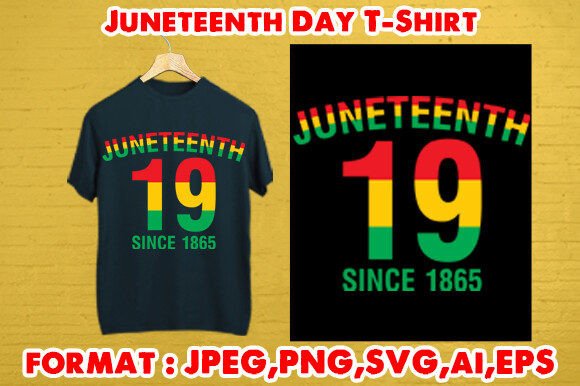
Juneteenth Day T-Shirt
A Designer’s First Look: Clean, Celebratory, and Commercially Smart
When I opened Juneteenth Day T-Shirt for the first time, what struck me wasn’t just the symbolism—it was the design’s quiet confidence. It reads as joyful without being loud, respectful without feeling stiff, and graphic without sacrificing warmth. The layout balances positive space and visual weight in a way that feels intentional—not rushed or templated. As an embroidery designer who’s stitched hundreds of holiday and cultural designs, I immediately saw its versatility: this isn’t just a t-shirt graphic. It’s a machine embroidery design waiting to live on sweatshirts, tote bags, aprons, and even nursery pillows—provided you approach it with thoughtful execution.
Where It Shines: Real Embroidery Use Cases That Feel Authentic
I recently prepped a batch of custom embroidered tote bags for a local community center’s Juneteenth celebration—and Juneteenth Day T-Shirt was my top candidate. Why? Its central motif has clear silhouette definition and moderate detail, making it ideal for medium-density fill stitch work on cotton canvas. On a sweatshirt? It holds up beautifully when digitized with balanced satin stitch borders and open areas that prevent puckering. For baby embroidery—say, on a soft organic cotton onesie—I’d simplify the inner text slightly (more on that below), but the core shape translates with sincerity and scale.
It also works well as an embroidered patch: clean edges, no micro-details, and a composition that reads clearly at 3–4 inches wide. As a boutique owner, I’ve used it on tea towels and pillow covers with excellent results—especially when paired with high-contrast thread colors like navy on cream or charcoal on oat. Customers consistently comment on how “handmade” it feels—even though it’s a digital embroidery file—because the design avoids overcomplication and honors negative space.
Where to Proceed Thoughtfully: Fabric, Scale, and Stitch Integrity
This isn’t a one-size-fits-all embroidery file. Its strength lies in clarity—but that clarity can blur under certain conditions. On thin or stretchy fabrics (like lightweight jersey or ribbed knit), I recommend testing Juneteenth Day T-Shirt with tear-away + cut-away stabilizer combo and reducing stitch density by 5–10% in dense areas. On dark fabric, double-check that any light-colored text or fine linework remains legible after stitching—some versions of this design include subtle script elements that may vanish without sufficient thread contrast.
Curved surfaces—like caps or curved apron pockets—require repositioning the design to avoid distortion. I always rotate or mirror-test the layout digitally before hooping. And for small hoop sizes (under 4×4 inches), avoid using the full composition unless you’re willing to omit minor decorative flourishes. The lettering, while legible at 5 inches, becomes fragile below 3 inches—so for baby embroidery or tiny patches, prioritize the central icon over full text.
Design Assets That Support, Not Sabotage, Your Craft Business
What makes Juneteenth Day T-Shirt stand out among T-Shirt Designs is how easily it bridges digital and physical craft. As a Graphics asset, it gives Etsy sellers and small shop owners flexibility: use the PNG for printable mockups, the EPS for vector scaling, or the JPEG for quick client previews. But remember—none of those formats stitch. You’ll need to digitize it properly (or source a pre-digitized version) before running it on your machine. Don’t assume the included files are embroidery-ready; they’re design assets, not embroidery files.
For commercial embroidery, licensing matters. Since the listing mentions KDP and POD use, confirm whether the license extends to stitched, finished products you sell directly—or only to printed items. I’ve seen creators get tripped up assuming “KDP Interior Coloring Books” permissions cover embroidered tote bags. When in doubt, reach out to the seller or review the license terms before listing on Etsy or at a craft fair.
Practical Notes Every Embroidery Designer Should Run Through
- Test on scrap fabric first—especially if using textured weaves like linen-blend tea towels or looped terry cloth.
- Check thread color contrast across multiple backgrounds: light, dark, and mid-tone fabric swatches.
- Review stitch density in tight corners and lettering—dense fills can overwhelm delicate fabrics.
- Confirm hoop size compatibility before digitizing; some versions of this design exceed 5×7” dimensions.
- Inspect small details like punctuation, fine lines, or internal shapes—they often disappear in satin stitch without manual cleanup.
- Test black-and-white mockups to assess value contrast before committing to thread choices.
- Compare performance on light vs. dark fabric—what reads boldly on white may fade on charcoal without adjusted underlay.
- Use proper stabilizer: cut-away for knits, tear-away for stable wovens, and fusible + tear-away for lightweight silks or voiles.
- Verify dual-use rights—can you use it for both personal projects *and* commercial embroidery? Don’t assume.
Why This Design Builds Trust—Not Just Traffic
In my experience, customers don’t just buy Juneteenth-themed items—they buy intention. A rushed or generic design undermines the meaning behind the day. Juneteenth Day T-Shirt avoids cliché. It doesn’t lean on overused motifs or forced slogans. Instead, it offers dignity through simplicity—making it perfect for personalized gifts, boutique branding, or handmade product lines where authenticity matters more than trend-chasing.
When stitched well, it elevates the perceived value of your finished product. A customer receiving a hand-embroidered kitchen towel with this design doesn’t just see decoration—they sense care, cultural awareness, and craftsmanship. That builds repeat business, word-of-mouth referrals, and long-term brand consistency—especially for creative entrepreneurs building a values-aligned craft business.
Final Thought: A Thoughtful Tool, Not a Magic Button
Juneteenth Day T-Shirt is a strong, adaptable design—but like any quality digital embroidery file, its success depends on your judgment, not just its pixels. It rewards attention to fabric, stabilizer, thread choice, and context. Used wisely, it becomes part of meaningful holiday embroidery, custom apparel, and heartfelt personalized gifts. Used hastily, it risks looking flat or disconnected from its purpose.
So take the time. Test it. Refine it. Let it serve your people—not just your pipeline.