Canva Notebook Papers KDP Interior
A Designer’s First Glance: Clean, Quiet, and Full of Potential
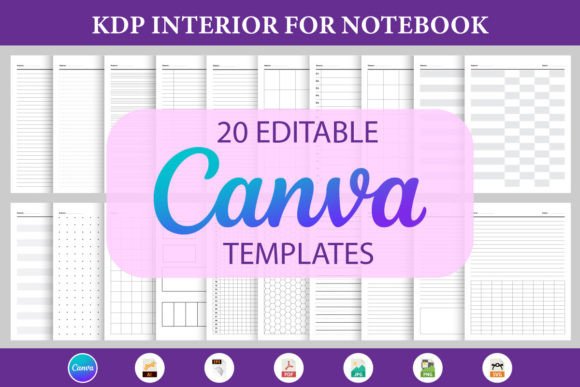
When I opened Canva Notebook Papers KDP Interior, my first thought wasn’t “Oh, another notebook template.” It was, “This could actually live on a linen tea towel or stitched onto a canvas tote bag — softly, clearly, and with quiet confidence.” The collection feels like a curated stationery sketchbook: lined pages, dotted grids, subtle margins, and clean headers — all designed to evoke focus, creativity, and calm. There’s no loud ornamentation, no forced whimsy. Just structure with breathing room. That restraint is exactly what makes it promising for embroidery — especially when you’re stitching for clients who value understated elegance over flash.
Real-World Test: Stitching It Onto a Linen Apron for a Local Bakery
Last week, I used one of the lined-paper designs from Canva Notebook Papers KDP Interior as the centerpiece for a custom apron order from a neighborhood sourdough bakery. Their request? “Something that looks hand-drawn but feels professional — like our recipe journal.” I chose a simple ruled-page layout with a small serif header (“Daily Loaf Notes”) and scaled it to fit a 4” x 5” hoop. On medium-weight linen, with medium-cutaway stabilizer and matte cotton thread, it stitched cleanly. No skipped stitches. No thread breaks. The lines stayed crisp, the spacing held, and the overall effect read as intentional — not digital, not generic, but *designed*.
Where It Shines in Embroidery Projects
- Embroidered tote bag design: Perfect for minimalist boutique branding — think canvas bags with a single ruled page motif near the hem.
- Sweatshirt embroidery: Works beautifully on the upper back or chest when simplified to one clean grid or margin line.
- Baby embroidery: A soft dotted-grid version reads gently on organic cotton onesies — no sharp edges, no visual noise.
- Personalized gift: Pair a name or date with a subtle notebook border for nursery decor or teacher appreciation.
- Commercial embroidery: Ideal for small shops selling printable mockups or digital embroidery files — the Canva Editable Link lets clients tweak fonts or spacing before stitching.
Where to Proceed With Care
This isn’t a high-contrast, bold-outline design — and that’s its strength *and* its limitation. On dark fabric, fine ruled lines can disappear without careful thread color selection. On stretchy fabric like jersey, even light fill-stitch areas (like shaded headers) may distort unless stabilized properly. And on curved surfaces — say, a cap brim — tight corner details or dense text blocks risk puckering if not digitized with gentle underlay.
I’d avoid using the most detailed versions (like multi-column lined pages with footers) for embroidered patch work under 3”. Tiny margins and thin horizontal rules get lost in satin stitch transitions. Likewise, on textured fabrics like terry cloth or bouclé, the subtlety of the lines may blur — better suited to smooth cotton, linen, or twill.
What It Adds — and What It Doesn’t Promise
Canva Notebook Papers KDP Interior doesn’t shout. It invites. That makes it powerful for handmade product positioning: customers associate clean layouts with craftsmanship, attention to detail, and thoughtful gifting. It elevates a plain tea towel into a kitchen heirloom. It gives a baby onesie quiet personality instead of cartoon clutter. But it won’t carry weight on its own — it needs smart placement, considered thread palette, and context. A single ruled line stitched in ecru on oatmeal linen says “curated.” The same line in neon pink on black denim says “confused.”
Practical Notes Every Embroidery Designer Should Check
- Test on scrap fabric first — especially if using fill-stitch headers or shaded margins. See how density behaves on your machine and fabric combo.
- Review stitch density in your embroidery software. Some versions include light running-stitch guides — great for tracing, but easy to overlook during hooping.
- Confirm hoop size compatibility. While the PDF and AI files scale well, very narrow ruled layouts may need manual adjustment for sub-3” hoops.
- Inspect small details at 200% zoom: are margins consistent? Do corner radii hold up? Does text remain legible at 8pt equivalent?
- Try black-and-white mockups — this design lives or dies by contrast. If it fades in grayscale, it’ll fade on dark fabric.
- Use proper stabilizer. Even simple lines need support on lightweight or loosely woven fabrics.
- Check licensing before selling finished products or bundling the files. Since this is labeled as a Graphics asset with Canva Editable Link + AI/EPS/PDF/Text formats, commercial use likely depends on your Canva license tier — verify before listing on Etsy or launching a craft business bundle.
Final Thought: A Design That Respects the Handmade
As an embroidery designer who’s seen too many “cute” graphics collapse under thread tension or fail to translate from screen to stitch, I appreciate how Canva Notebook Papers KDP Interior honors the medium. It’s not trying to be everything. It’s a quiet, flexible foundation — for the baker who wants her recipes stitched, the teacher who loves handwritten notes, the Etsy seller building a cohesive stationery-meets-textile brand. It won’t wow at first glance, but it earns trust over time: in the clean line, the balanced spacing, the way it holds up after five washes on a kitchen towel. That kind of reliability — subtle, scalable, sincere — is rare. And worth keeping in your design assets.