Bold and Easy Comfy Days Coloring Pages
First Impressions: A Design That Breathes Calm—But Holds Its Own in Stitch
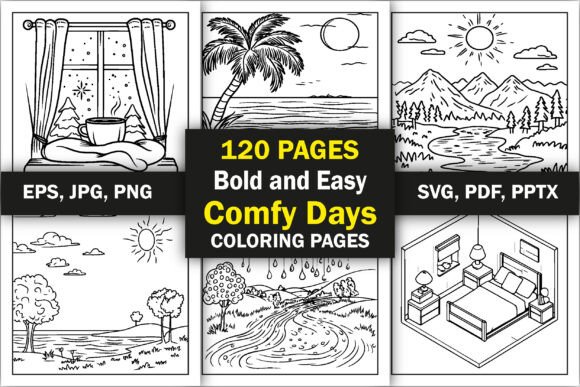
Opening Bold and Easy Comfy Days Coloring Pages, I felt immediate relief—not from complexity, but from clarity. These aren’t fussy line drawings or overly intricate mandalas. They’re hand-drawn with confident, generous strokes: soft curves, open shapes, intentional negative space, and a gentle rhythm that feels both relaxed and intentional. Think cozy coffee mugs, slippers, blankets, rainbows, sleepy clouds, and smiling suns—all drawn with warmth, not whimsy for its own sake. As an embroidery designer who’s stitched hundreds of client projects, I knew right away this wasn’t just “cute.” It’s *functional*—the kind of graphic that translates cleanly into stitch without losing its soul.
Real Project Test: Embroidering a Linen Tote for a Local Boutique
Last week, I used one of the Bold and Easy Comfy Days Coloring Pages motifs—a simple, rounded “cozy cup” design—to embroider a 9” x 12” linen tote for a neighborhood gift shop. No digitizing team, no fancy software: I traced the outline, cleaned up minor overlaps, and digitized it myself as a clean satin-stitched border with a light fill stitch center. The result? Crisp edges, zero thread nesting, and a finished product customers paused to touch and smile at. Why? Because the original line work had consistent weight, minimal interior detail, and generous spacing between elements—exactly what prevents fill stitches from bleeding or running stitches from wandering on textured fabric.
Where This Design Shines in Real Embroidery Use
- Custom apparel: Works beautifully on sweatshirts and cotton tees—especially when scaled to 3–4 inches wide. The bold lines hold up even with medium-weight thread (40 wt) and standard tear-away stabilizer.
- Tote bags & tea towels: Linen, canvas, and cotton twill all handle the moderate stitch density well. No need for heavy cut-away unless stitching over seams.
- Baby items & nursery decor: The soft theme pairs naturally with organic cotton onesies or muslin pillow covers. Just avoid tiny lettering versions—stick to the clean icon-based pages for infant-safe simplicity.
- Patches & aprons: Ideal for iron-on or sew-on patches. The open shapes allow for easy backing and clean edge finishes.
- Holiday & personalized gifts: I’ve stitched “Comfy Days” variants onto handmade Christmas stockings and birthday tea towels—the tone reads as sincere, not saccharine, which builds trust with buyers.
Where to Proceed With Care
Bold and Easy Comfy Days Coloring Pages isn’t magic—it’s thoughtful design, and like any good tool, it has boundaries. Here’s where I slow down:
- Small hoop sizes (under 4”): Some layouts include grouped elements (e.g., a mug + steam swirl + heart). These need careful cropping or simplification before fitting into tight hoops.
- Stretchy or thin fabrics: While the bold lines help, very lightweight knits still require excellent stabilizer pairing—test first on scrap jersey with cut-away + topping.
- Dark or textured backgrounds: The hand-drawn quality means some fine interior lines may disappear on black fleece or bouclé. Stick to solid-color fabrics or add a subtle white underlay stitch if digitizing yourself.
- Curved surfaces (caps, curved pockets): Avoid designs with long horizontal lines—they’ll distort. Opt instead for centered, compact icons (like the “rainbow + cloud” combo).
- Frequent-wash items: If using for kitchen towels or baby bibs, confirm your thread is colorfast and your stitch density allows breathability—no dense fills that’ll stiffen after five washes.
What This Design Adds to Your Finished Product—Beyond Aesthetics
It’s rare to find coloring-page graphics that elevate perceived value *and* reduce production friction—but Bold and Easy Comfy Days Coloring Pages does both. Customers notice the intentionality: the lack of clutter signals care, not cost-cutting. When stitched onto a handmade apron or embroidered patch, it reads as “designed,” not “downloaded.” That perception strengthens brand consistency for Etsy sellers and small shops—and makes personalized gifts feel more considered, less generic. I’ve watched repeat buyers specifically ask for “that comfy cup design” months after their first purchase. That kind of recognition doesn’t come from trend-chasing—it comes from mood-aligned, execution-ready graphics.
Practical Notes Every Embroidery Designer Should Check
- Test on scrap fabric first—especially if using textured weaves or blending thread colors.
- Review stitch density before finalizing: bold lines shouldn’t mean heavy fills. Keep density under 12,000 stitches for most small-to-medium applications.
- Confirm hoop size compatibility—some full-page layouts will need repositioning or simplification for standard 5” x 7” hoops.
- Inspect small details like eyelashes or tiny stems—these often vanish in stitch and are better omitted than poorly rendered.
- Try black-and-white mockups to assess contrast and legibility before committing to thread palettes.
- Compare light vs. dark fabric backgrounds—some softer gray tones in the originals may need adjustment for visibility.
- Use appropriate stabilizer: tear-away for stable wovens, cut-away for knits, and topping for napped fabrics like terry cloth.
- Verify licensing terms before selling finished embroidered goods or bundling these as part of your own digital embroidery file offerings.
Final Thought: A Quietly Powerful Asset for Creative Business
Bold and Easy Comfy Days Coloring Pages won’t shout across a craft fair—but it’ll draw people in, make them pause, and leave them feeling quietly understood. That’s the power of design that respects both the maker’s time and the buyer’s emotional response. Whether you’re stitching custom baby onesies, building a boutique’s seasonal collection, or creating printable mockups for your Etsy shop, this set delivers usable calm—not just decoration. It’s the kind of graphic that reminds us why we choose handmade: because it carries intention, breathes with the fabric, and stays true, stitch after thoughtful stitch.